



需要帮助申请中国签证吗?
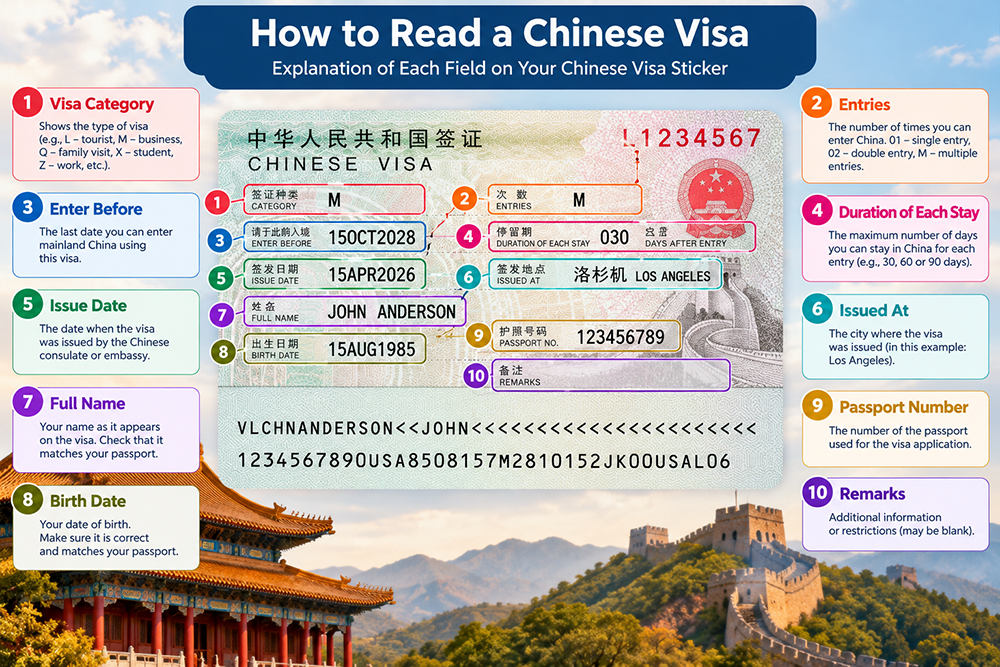
Chinese visa has the following numbered fields:
1 – CATEGORY:
China Visa category as defined by Chinese Embassy
2 – ENTRIES:
Number of allowed entries to China (subject to visa validity dates).
“M” – stands for “Multiple Entry”
3 – ENTER BEFORE:
Expiration date of your visa
4 – DURATION OF EACH STAY:
Maximum duration of stay in China per each entry.
5 – ISSUE DATE:
Chinese Visa issue date
(format might be different from MM-DD-YYYY).
6 – ISSUED AT:
Chinese Consulate that issued a visa.
7 – FULL NAME:
First Name and Last Name
8 – BIRTH DATE:
Your Date of Birth
(format might be different from MM-DD-YYYY).
9 – PASSPORT NUMBER:
Traveler’s passport number.
10 – REMARKS:
Chinese Visa remarks.
Dokument USA specialize in services to expedite a Chinese tourist visa application in Los Angeles
 Apply for Chinese Travel Visa now
QUESTIONS?
Email us at info@dokumentusa.com or call us at (323) 650-2233.
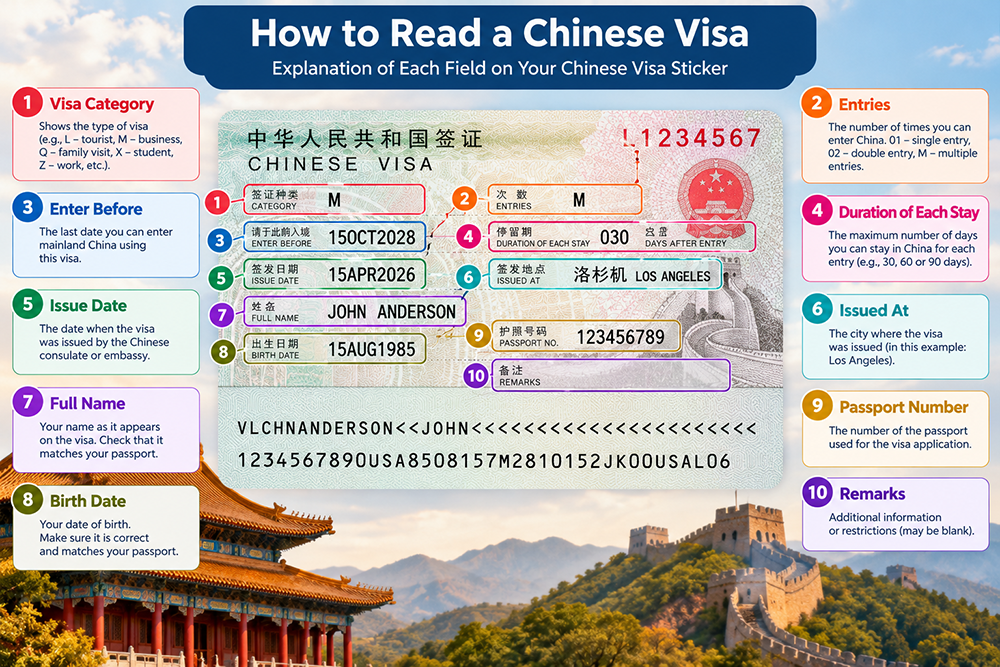
How to Read a Chinese Visa: A Complete Field-by-Field Guide
Before traveling, carefully compare the information on your Chinese visa with your passport and travel itinerary. A valid Chinese visa does not automatically mean you can enter China at any time or remain there for the entire validity period — your travel plans must also comply with the permitted entries and duration of stay. Our Los Angeles team at Dokument USA regularly helps Southern California travelers review these details before departure.
1. CATEGORY — Understanding Your Chinese Visa Type
The CATEGORY field identifies the type of Chinese visa issued to you. Different visa categories correspond to different purposes of travel, such as tourism, business, employment, education, or family visits.
Common Chinese visa categories include:
L Visa — Tourist Visa
Generally issued to eligible foreign nationals traveling to China for tourism.
M Visa — Business Visa
Typically used for commercial and trade-related activities.
F Visa — Exchange and Visit Visa
Generally intended for certain noncommercial visits, exchanges, and related activities.
Q1 & Q2 Visas — Family Visits
Issued to qualifying applicants visiting family members in China, with different requirements depending on circumstances and intended length of stay.
S1 & S2 Visas — Private Affairs & Family Visits
Used for certain visits involving foreign nationals residing in China and other qualifying private matters.
X1 & X2 Visas — Student Visas
Issued for qualifying educational programs, with the category depending on the intended study period.
Z Visa — Work Visa
Generally issued to foreign nationals entering China for authorized employment.
The visa category matters because it determines the purpose for which the visa was issued. For example, holding an L tourist visa does not automatically authorize employment in China.
Always verify that your visa category corresponds to your intended activities.
2. ENTRIES — How Many Times Can You Enter China?
The ENTRIES field indicates how many times you may enter mainland China during the visa’s validity period. You may see:
01 — Single Entry
You may enter mainland China once using this visa. After that entry is used, the visa cannot normally be used again, even if the expiration date has not passed.
02 — Double Entry
You may enter mainland China twice during the visa’s validity period.
M — Multiple Entries
You may enter mainland China multiple times while the visa remains valid, subject to its conditions and applicable entry requirements.
Example: Understanding Multiple Entries
Imagine you receive a Chinese visa with the following information: Category L, Entries M, Enter Before October 15, 2028, Duration of Each Stay 60 days.
This generally means you may make multiple visits to mainland China before the visa expires, with each visit subject to the stated 60-day stay limit. It does not mean you can remain continuously in China until October 2028.
Important: Leaving mainland China for another destination, including Hong Kong or Macau, may affect the number of entries required for your itinerary. Check your travel arrangements carefully.
3. ENTER BEFORE — Understanding Your Chinese Visa Expiration Date
One of the most important fields on a Chinese visa is ENTER BEFORE. This date indicates the end of the period during which the visa may be used to enter mainland China.
For example, ENTER BEFORE: 15OCT2028 means the visa’s entry validity ends on October 15, 2028, subject to the applicable rules and any unused permitted entries. The date does not necessarily indicate when you must leave China.
Can You Enter China on the Visa Expiration Date?
Under the general rules for Chinese visas, entry may be permitted before midnight Beijing Time on the final day of validity, provided that the visa still has an available entry and all other requirements are satisfied.
However, planning to arrive on the final day can be risky. Flight delays, time-zone differences, or unexpected travel disruptions may prevent you from arriving before the deadline.
Whenever possible, avoid scheduling international travel too close to your visa’s expiration date. If you’re unsure how to read your own ENTER BEFORE date, our Los Angeles visa specialists can review your documents with you before you book travel.
Not Sure What Your Visa Fields Mean?
Dokument USA’s Los Angeles office can review your Chinese visa and travel itinerary together, so you know exactly what’s permitted before you fly.
4. DURATION OF EACH STAY — How Long Can You Stay in China?
The DURATION OF EACH STAY field indicates the maximum permitted stay for each entry. For example, DURATION OF EACH STAY: 030 DAYS generally means the traveler may stay for up to 30 days per permitted entry. A visa showing 60 days allows a maximum stay of 60 days per entry, subject to the visa’s conditions.
When Does the Duration of Stay Begin?
Under the general Chinese visa rules, the duration of stay is calculated beginning on the day following entry into China. For example, if you enter mainland China on June 1 with a permitted stay of 30 days, the first counted day is June 2. You should calculate your departure deadline carefully and verify any conditions imposed by immigration authorities.
Visa Validity vs. Duration of Stay
These two terms are frequently confused. Visa validity determines the period during which you may use the visa to enter China. Duration of stay determines how long you may remain in China after each entry.
For example, a visa may remain valid for several years while permitting stays of only 30 or 60 days per visit.
Do not assume that a long-term visa allows you to live in China continuously.
5. ISSUE DATE — When Was Your Chinese Visa Issued?
The ISSUE DATE identifies when the Chinese embassy or consulate issued your visa. It is different from the expiration date. For example, ISSUE DATE: 15APR2026 indicates that the visa was issued on April 15, 2026. The issuance date can help you understand the visa’s overall validity period.
Chinese visa dates may be displayed differently from the date formats commonly used in the United States. Always read the month and year carefully.
6. ISSUED AT — Where Was Your Chinese Visa Issued?
The ISSUED AT field identifies the Chinese diplomatic or consular office responsible for issuing the visa. Depending on the application, the issuing location may correspond to a Chinese embassy or consulate.
This information is primarily administrative. It does not mean that you must enter China through a particular airport or city.
7. FULL NAME — Checking Your Personal Information
The FULL NAME field identifies the visa holder. The printed name may sometimes appear in an abbreviated format. For example, a traveler named Michael Anderson may see an abbreviated version of their name on the visa sticker. However, the complete identifying information should correspond to the passport and the machine-readable information associated with the visa.
What If Your Name Is Incorrect?
If you notice a spelling error or another discrepancy, contact the issuing authority or appropriate visa service provider before traveling. Do not assume that an incorrect name will be accepted by an airline or immigration officer.
8. BIRTH DATE — Understanding the Date Format
The BIRTH DATE field displays the visa holder’s date of birth. Because date formats differ internationally, travelers should check this field carefully. For example, a date displayed as 15AUG1985 means August 15, 1985.
Compare the date with your passport to ensure the information is accurate. If you notice an error, seek clarification before departure.
9. PASSPORT NUMBER — Where to Find It on a Chinese Visa
The PASSPORT NUMBER field identifies the passport associated with the Chinese visa. This is particularly important because the visa was issued using a specific travel document. Before traveling, verify that the passport number printed on the visa matches the passport information used in your application.
What If You Have a New Passport but Your Chinese Visa Is in Your Old Passport?
In certain circumstances, travelers may be permitted to use a valid Chinese visa in an expired or replaced passport while carrying both the old and new passports. However, eligibility depends on factors such as nationality, visa type, and whether the identifying information remains consistent.
Do not assume that every visa can be transferred or used in this manner. Confirm the current requirements with the appropriate Chinese consulate before traveling.
10. REMARKS — Additional Information on Your Visa
The REMARKS field may contain additional information or restrictions relevant to the visa. Not every visa contains the same remarks.
If your visa includes a special notation, make sure you understand its meaning before traveling. Contact the issuing authority if any information is unclear.
Chinese Visa Number: Where Is It Located?
Travelers frequently search for the location of their Chinese visa number when completing airline forms, travel documents, or immigration paperwork. The Chinese visa number is a unique identifier associated with the visa itself — it is not the same as your passport number.
Depending on the visa sticker format, the visa number may appear separately from the personal information fields. When looking for it, examine the entire visa sticker carefully rather than assuming that the number under PASSPORT NUMBER is your visa number.
If an airline or another organization requests your visa number, use the identifier corresponding to the visa document, not your passport number. If you are uncertain which number is required, confirm the correct field before submitting your information.
How to Read a Multiple-Entry Chinese Visa
Multiple-entry visas can be especially useful for travelers who visit China frequently for tourism, business, or family reasons. However, three conditions must be checked before every trip:
✓The visa must still be valid. Check the ENTER BEFORE date.
✓The visa must allow another entry. Look for M in the ENTRIES field or confirm that an unused entry remains.
✓Your planned stay must comply with the permitted duration. Review the DURATION OF EACH STAY field.
Practical Example
Suppose a business traveler has a Chinese visa showing: Category M, Entries M, Enter Before December 10, 2028, Duration of Each Stay 30 days.
The traveler may generally make multiple business visits during the validity period, provided that each entry satisfies the applicable requirements. However, each permitted stay is limited to the duration stated on the visa. A multiple-entry visa does not automatically authorize permanent residence or unrestricted employment.
Common Mistakes When Reading a Chinese Visa
Understanding the visa sticker can help prevent problems at the airport or border. Here are several mistakes travelers should avoid.
!Confusing the expiration date with the departure deadline. The ENTER BEFORE date relates to entry validity — it is not necessarily the date by which you must leave China.
!Assuming a multiple-entry visa allows unlimited stay. Multiple entries and duration of stay are separate conditions — you must comply with both.
!Ignoring passport information. An incorrect passport number or personal detail can create travel complications.
!Overlooking the visa category. Different visa categories permit different travel purposes — always make sure your activities match the category issued.
!Traveling with an expired visa. Even if a visa still shows unused entries, it generally cannot be used for entry after its validity expires.
!Assuming a visa guarantees admission. A valid visa does not guarantee entry into China — Chinese border authorities make the final admission decision.
Avoid These Mistakes on Your Next Application
A small misread field can cause real problems at the border. Dokument USA’s Los Angeles team can help you prepare and double-check your next Chinese visa application before you travel.
What Should You Check Before Traveling to China?
Before leaving the United States, review the following information:
✓Confirm that your passport meets the applicable entry requirements
✓Verify that your Chinese visa is valid for your intended arrival date
✓Check that the visa permits the necessary number of entries
✓Confirm the maximum duration of each stay
✓Review your visa category
✓Check your name, date of birth, and passport number
✓Review any special remarks or restrictions
✓Confirm current entry requirements with the relevant Chinese authorities
Taking a few minutes to review your documents can help prevent avoidable problems during international travel.
Planning a Trip to China?
Whether this is your first Chinese visa or a renewal, our Los Angeles office can walk through every field with you and help prepare your next application.
Frequently Asked Questions About Chinese Visas
How do I read a Chinese visa?+
Start by identifying the visa category, number of entries, expiration date, and duration of each stay on your Chinese visa. Then verify your personal information, including your name, date of birth, and passport number.
Where is the Chinese visa number located?+
The visa number is a unique identifier printed on the visa sticker. Its exact location may depend on the visa format. It is different from your passport number.
What does M mean on a Chinese visa?+
The meaning depends on the field. Under ENTRIES, M means multiple entries. Under CATEGORY, M identifies a business visa generally associated with commercial and trade activities.
What does 01 mean under Entries?+
It means the visa permits one entry into mainland China during its validity period.
What does 02 mean on a Chinese visa?+
Under ENTRIES, 02 indicates that the visa permits two entries into mainland China during its validity period.
What does Enter Before mean?+
ENTER BEFORE identifies the last date on which the visa may generally be used to enter mainland China, subject to its conditions.
Can I enter China on the expiration date of my visa?+
Under the general rules, entry may be permitted before midnight Beijing Time on the final day of validity if an entry remains available. However, travelers should avoid relying on last-minute arrival.
Does a 10-year Chinese visa allow me to stay for 10 years?+
No. A 10-year validity period does not mean you can remain in China continuously for 10 years. The duration of each stay is specified separately.
How long can I stay in China with a tourist visa?+
The permitted stay depends on the visa issued. Check the DURATION OF EACH STAY field for the maximum number of days allowed per entry.
Can I use my Chinese visa after renewing my passport?+
Sometimes. Certain travelers may be able to carry a valid visa in an old passport together with a new passport. The applicable conditions must be verified before traveling.
What happens if my Chinese visa expires?+
An expired visa generally cannot be used for a new entry. You may need to apply for a new visa unless another lawful entry arrangement applies.
What is the difference between visa validity and duration of stay?+
Visa validity determines when you may use the visa to enter China. Duration of stay determines how long you may remain after each entry.
What happens if I overstay my Chinese visa?+
Overstaying can result in penalties, including fines and other immigration consequences. Travelers should follow the permitted stay period and contact the appropriate immigration authority if they encounter an unexpected problem.
Is a Chinese visa required for every U.S. citizen visiting China?+
Not necessarily in every circumstance. Requirements depend on the traveler’s itinerary, purpose of travel, and any applicable visa-free or transit arrangements. U.S. citizens should verify the current rules before departure.
Can Dokument USA help me apply for a Chinese visa?+
Yes. Dokument USA provides Chinese visa application assistance, including guidance on required documentation and application preparation. If you are planning a trip to China and need help understanding the application process, contact our team to discuss your travel documentation needs.
Need Help Applying for a Chinese Visa?
Understanding your existing Chinese visa is important, but preparing a new visa application can involve additional requirements. Whether you are planning a vacation, visiting family, or traveling for business, proper documentation can help make the application process more manageable. Dokument USA provides Chinese visa application assistance for travelers in Los Angeles and surrounding Southern California communities.
Learn More About Chinese Visa Services in Los Angeles
Or call us at (323) 650-2233 / email info@dokumentusa.com
Disclaimer: This guide provides general information about Chinese visa stickers and is not a substitute for official immigration guidance. Visa rules and entry requirements may change. Always confirm current requirements with the appropriate Chinese diplomatic or immigration authorities.